Home » Doing business abroad » DigiChambers: Non-preferential Certificates of origin

Non-preferential certificates of origin

The non-preferential certificate of origin is an official administrative document stating the product’s country of origin.

Chambers of Commerce are authorised by the Federal Public Service Economy to issue non-preferential certificates of origin. Only chamber employees who have followed a training course and passed an exam can issue certificates of origin. In addition, the Chambers are regularly audited by the Federation and the Federal Public Service Economy. We guarantee that exporters receive the best possible advice on origin and that the certificates issued meet all legal requirements.
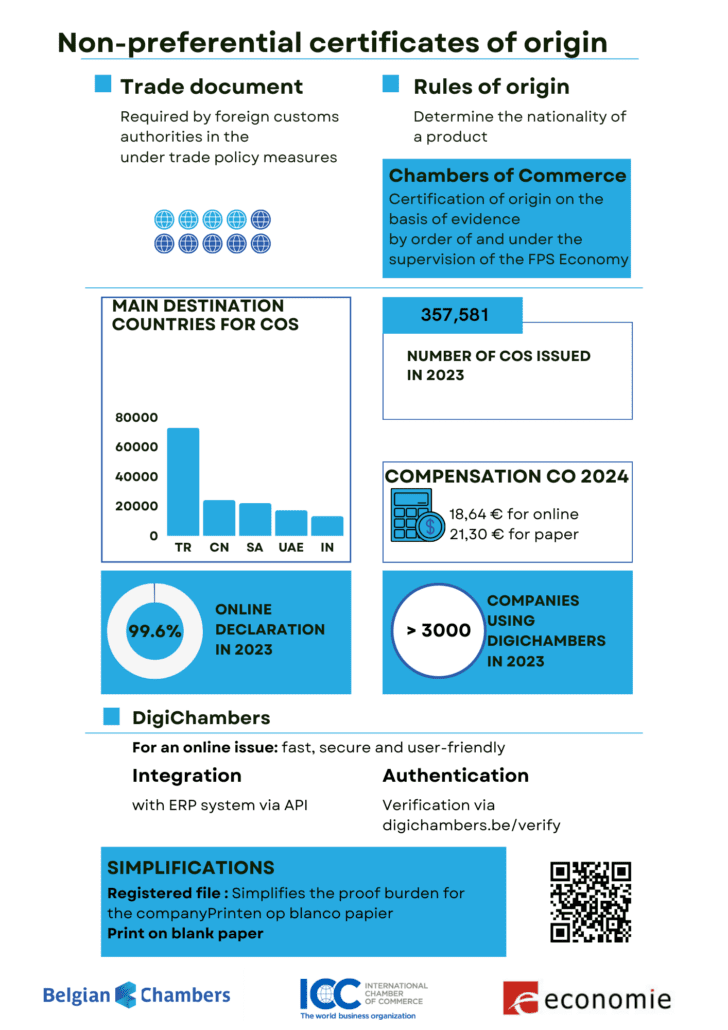
Comfortably applying for and printing your certificate of origin?

Our online application DigiChambers makes it easy for you!

  • You receive certificates of origin in electronic form and can print them on blank paper.
  • You re-use old data.
  • You create and use templates.
  • You can integrate your ERP system with DigiChambers and request your certificates of origin fully automatically.
  • You manage requests thanks to a dashboard that guarantees simple and real-time monitoring.
  • You can also have your invoices and other documents stamped via DigiChambers.

And all this from behind your desk, quickly and in a secure environment!

Never heard of DigiChambers?

Contact your Chamber of Commerce for more information or check the demo.

You would rather go to your Chamber in person? Then don’t forget to print the form (FR / NL).

Non-preferential and preferential origin (source: FPS Economy)

A product’s origin relates to the country where it was produced. In other words, it is a product’s nationality. This concept is essential for customs formalities concerning handling goods imported or manufactured in the European Union, or for goods being exported to third countries. We draw a distinction between non-preferential and preferential origin. In Belgium the Federal Public Service Economy is the competent authority for origin.

Non-preferential origin

When is the non-preferential origin of importance?

Among other things, the non-preferential origin is important for:

  • the application of any quota;
  • the application of anti-dumping rights;
  • if an indication of origin was introduced to the product or its packaging (e.g. “made in Belgium”);
  • if political measures are taken such as boycotts or embargoes.

The certificate of origin

The certificate of origin is an official administrative document stating the product’s country of origin. When importing, this document must sometimes be presented to the customs authorities of certain third countries. Within the framework of a letter of credit, it is necessary to be able to receive payment of the consignment. The certificates of origin are issued in Belgium by bodies authorised by the Minister of Economy, in particular the Chambers of Commerce and the Antwerp World Diamond Centre for diamonds.

Determining the origin

Determining the country of origin is fairly straightforward if the product was entirely obtained in one country. These, for instance, include agricultural and horticultural produce. If raw materials and/or components for manufacturing products are from two or more countries, this can cause problems for determining the origin. The origin of the goods can be determined in this case, thanks to the origin rules, or the methods as a whole based on the composition of the products and/or production method.

Preferential origin

Favourable import duties

The European Union has concluded trade agreements with various countries, in which favourable import rights are provided. A Belgian importer is thus able to ensure its customers outside the EU are also eligible for a reduction or exemption from import fees. Among other things, the exporter must provide evidence that the exported goods fall under the preferential origin arrangement.

Certification

This evidence is the EUR.1, EUR-MED, certificate, or a declaration on the invoice send along with the goods exported. The EUR.1 and EUR-MED certificates are issued by the Customs and Excise Administration.

The EU is progressively rolling out an auto-certification system (REX) which foresees that proof of preferential origin will be issued exclusively by exporters registered in the European Commission’s REX database. Find out more.

Both the preferential import rights for each country of origin (when importing into the EU) and the import duties in the export countries can be found in the European Commission’s Market Access Database.

Developing countries

If an economic operator imports goods from developing countries, he is also able to enjoy the General Preferential System (GPS). Within the scope of the GPS, the EU assigns unilateral tariff preferences to certain goods of beneficiary countries. The proof of origin is the FORM A certificate.

Chambers of Commerce in Belgium

There are 13 accredited Chambers of Commerce in Belgium. They represent the interests of companies at local, regional, national and international levels. They bring entrepreneurs into contact with each other and form a sounding board. They offer training and guidance, give advice and organise numerous networking events.

illustratie Kamers van Koophandel in België